


FAQs
Click a question below to see the answer.
Please contact us and let us know in that you would like to be added to the "Where to Buy" dealer search. Please note that there will be a delay to verify authenticity.
Improved corrosion resistance, more reliable electrical connections and long life in harsh environments.
The U.S. Coast Guard is accepting lights that have passed the UL tests (UL Standard 1104) as meeting the '72 COLREGS and the U.S. Inland Rules for vessels over 20 meters (65.6 ft.). As the first domestic manufacturer to pass UL 1104, Perko's lights can be installed on vessels over 20 meters (65.6 ft.). Perko manufactures two sizes of lights for the large boat market. The first group of lights is for vessels between 20 meters and 50 meters. The second group includes larger lights and is for vessels over 20 meters (without an upper limit on length).
A brass tag is permanently affixed to the light indicating the type of light, catalog number, voltage and bulb type to install to meet the visibility requirements. It also states that the light is classified by UL in accordance with the '72 COLREGS. This is the only documentation needed by a vessel in this size range for navigation lights to certify light construction compliance with the '72 COLREGS and the U.S. Inland rules.
Lights for these boats must be manufactured in accordance with the American Boat and Yacht Council (A.B.Y.C.) Standard A-16. The primary means of certification recognized in the United States for lights for these boats is through the National Marine Manufacturers Association (NMMA) certification procedure. USCG approved lights, as described below, are also approved for these applications.All PERKO small boat lights designed for use on boats built before 11/1/03 are certified under this NMMA Certification Procedure. All lights certified under this procedure are required to permanently carry the mark "A-16" visibly displayed when the light is installed.

The only recognized means of certification of lights for these boats is the USCG approval system. This system uses independent, 3rd party USCG approved labs to conduct some of the tests required for the A-16 certification. On all USCG approved lights, the permanent marking USCG 1nm, USCG 2nm or USCG 3nm (depending on whether the light is a 1-mile, 2-mile or 3-mile light) must be visible when the light is installed. Note that certifications may vary with voltage (e.g. USCG approved for 12-volt and A-16 certified for 24-volt).

Select a Globe Style
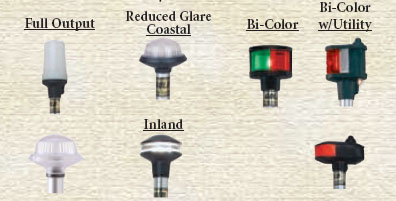
Globes come in three basic styles:
1. White all-round Full Output allows for full cockpit illumination. Choose traditional or modern styles.
2. White all-round Reduced Glare helps preserve night vision while under way. Choose clear top coastal or inland.
3. Bi-Color lights are used on the bow instead of a fixed surface mount light. Choose from models with or without integral white utility light.
Select a Rake Style
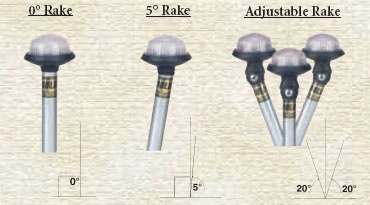
Rake is determined by the pole, base and base location angles. Rake is important for all reduced glare lights to insure that light output is correct. The most common rake angles are 0°, 5° and 16°. Custom made poles often have nonstandard rake angles. Choose from 0°, 5° or fully adjustable versions (Delta and Omega Series).
Determine if the Key Slot Screw Position is Important
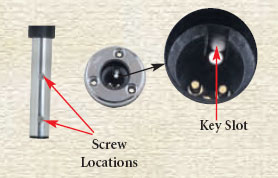
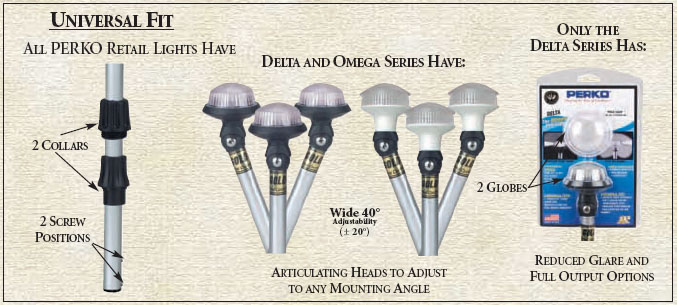
Most manufacturers insert screws into an upper or lower location on the pole to position the light and hold it properly oriented in the base. The location of this screw varies by manufacturer and model. Determine the key slot screw position needed for the base in your boat or the base you select and match it to the pole you select. All Perko plug in bases accept the upper screw position and all Perko lights have an upper screw. Perko Alpha, Delta and Omega Series replacement lights offer the option to locate the screw in either place.
Determine the Pole Length
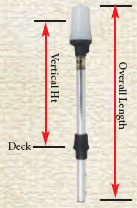
Navigation rules state that the center of the bulb filament of white lights must be mounted at least 1 meter (approx 40°) above center of the filament of the red/green lights. The "vertical height" of a light is measured from the deck of the boat to the center of the light filament. Most pole lights (all of Perko's) are sold by their "nominal(or approximate) overall length". Three factors affect the difference between overall length and vertical height.
1. The depth the pole goes into the base is typically less than two inches.
2. The distance from the filament to the top of the light is typically less than an inch.
3. Rake angle can shorten the vertical height by as much as an inch. (for bends under 16 degrees)
So, as a general rule, the installed "vertical height" will be between 2 and 4 inches less than the nominal length of the pole. Select the shortest light that will insure that the requirements are met after taking this difference into account. Be sure the light is long enough to be seen over any obstructions. If this light is too long to store easily, consider a fold-in-half light for easier storage.
Decide on a Collar Type
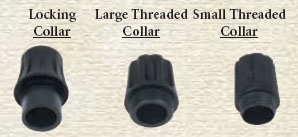
Some manufacturers use different types of collars to assure that their pole lights are held securely in the base. All Perko lights are shipped with at least one collar (an eccentric collar, a large threaded collar or a small threaded collar). Determine whether a collar is needed for the base in your boat or the base you want to use and match it by collar type to the pole you select. All Perko bases require collars.
Determine the Number of Pins
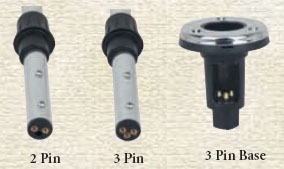
Bi-color lights are available with and without an integral white utility light. Those lights with a utility light require 3 contact pins. Determine if 2 or 3 contact pins are needed for the base in your boat or the base you select and match it to the pole you select.
On March 31, 1977, the U.S. Coast Guard published, in the Federal Register, an amendment to the navigation and navigable water regulations which added a new subchapter DD, (33 CFR 87). This subchapter contains rules implementing and interpreting the International Regulations for Preventing Collisions at Sea, 1972 ('72 COLREGS). The International Regulations for Preventing Collisions at Sea, 1960, were replaced by the '72 COLREGS at 1200 hours, zone time on July 15, 1977. Therefore, all vessels on the high seas must comply with the '72 COLREGS at this time. In addition, with the enactment of the U.S. Inland Navigation Rules Act of 1980, the Inland Rules, Western Rules, and Great Lakes Rules were unified into a single set of requirements. The effective date for this legislation was December 24, 1981 (March 1, 1983 for Great Lakes). Therefore, all vessels must comply with these rules at this time.
Rules 21 and 22 of the '72 COLREGS and the U.S. Inland Navigation Rules give the color and range requirements for various navigation lights. Annex 1 to the '72 COLREGS and the U.S. Inland Navigation Rules gives positioning and technical details for these lights.
U.S. Coast Guard Acceptance of Navigation Lights
All U.S. Registered vessels are subject to either the '72 COLREGS or the U.S. Inland Rules. The U.S. Coast Guard is accepting lights that have passed the UL tests (UL Standard 1104) as meeting the '72 COLREGS and the U.S. Inland Rules for vessels over 20 meters (65.6 ft.) in length. U.S. requirements for smaller vessels are less strict. As the first domestic manufacturer to pass UL 1104, Perko's lights can be installed on vessels over 20 meters (65.6 ft.) in length. Some models are designed for use on vessels over 20 meters (65.6 ft.) in length, while others are designed for use on vessels 20 meters (65.6 ft.) to 50 meters (164.0 ft.) in length.

A brass tag is permanently affixed to the light (see image below) indicating the type of light, catalog number, voltage and bulb type to install to meet the visibility requirements. It also states that the light is classified by UL in accordance with the '72 COLREGS. This is the only documentation needed by a vessel for navigation lights to certify light construction compliance with the '72 COLREGS and the Inland Navigation Rules, and eliminates the former "Certificate of Compliance".
Each Light has its own Serial Number for Identification
The lights indicated for use on vessels over 20 meters (65.6 ft.) in length have passed UL 1104. The facsimile of the tag shown above is used on our cast bronze lights. Similar rectangular tags are used on other style lights.
Please note that any changes made to PERKO navigation lights, including substitution of bulbs other than those shown in our catalog, instruction sheets, or metal tags (affixed to some lights) will void all certifications and U.S. Coast Guard acceptance.
For the present, the U.S. Coast Guard will not publish a list of UL classified lights. However, field offices have been notified. For more detailed information, consult the complete '72 COLREGS, the U.S. Inland Navigation Rules, and your local U.S. Coast Guard office.
Special Purpose Lights
Other lights (not shown) for use where the vessel is subject to special local requirements are available. Contact Perko for further information.
When standing outside - if the door opens away from you, then you need a Lock or Latch with a Regular Bevel. If the door opens toward you, then you need a Lock or Latch with a Reverse Bevel. See image below for additional help.

NOTE: The privacy latch handle should always be mounted on the door's interior side.
Battery disconnect switches help manage the overall use of electrical power on board. They are used to connect or disconnect electrical devices from the electrical system. They help to prevent battery drain during periods of inactivity. They allow for a quick and easy way to shut down the entire electrical system in an emergency. An optional key lock helps to prevent unauthorized use of the vessel.
In addition to doing everything a battery disconnect switch does, battery selector switches permit battery selection (of two or more batteries) for specific purposes including starting engines, running accessories or even recharging. They allow for the use of one or more batteries in systems with one or more engines and facilitate putting batteries in parallel for emergency starting when one or both batteries are substantially discharged.
All Perko battery disconnect switches and battery selector switches are UL listed, ignition protected and CE approved. This means they have been tested and certified by a respected outside agency, are designed to be used safely in a bilge where explosive fumes may be present and meet all the requirements for use and sale throughout the world.
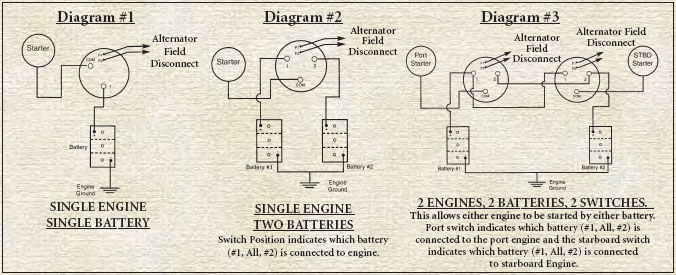
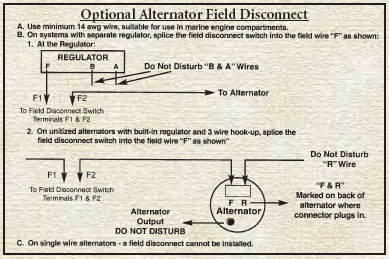
Perko battery switches are designed for surface mounting. Standard duty switches have a bright red polycarbonate housing for safety with a large easy-to-turn black knob. The housing of the heavy duty switches are red fiber-reinforced polycarbonate. Selector switches are designed with a "make before break" feature. This allows switching between the "1", the "all" and the "2" positions while the engine is running. Models with an "Alternator Field Disconnect" Feature offer protection for Non-Unitized Alternators should the switch accidentally be turned to the "Off" position with the engine running.
See images below for Perko battery switch connection diagrams.

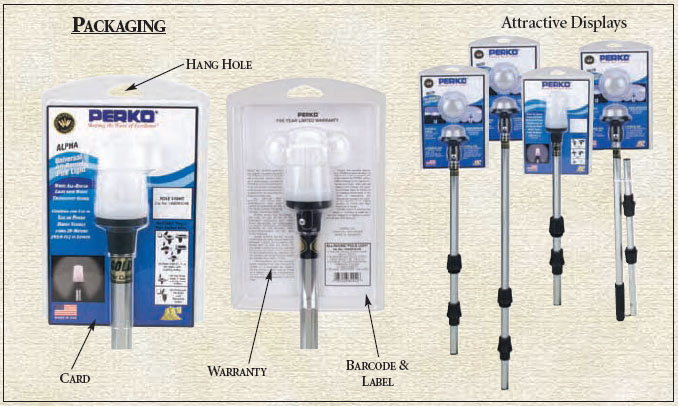
Packaged for retail sale
Barcoded and clearly labeled
Include installation instructions
Can be shipped in small quantities
Dealers save money and their customers save time
Universal Fit
Means less inventory for dealers and distributors
Customers can impulse buy safely
Additional Help Guides

Navigation Light Guidance
How to choose the right navigation lights for your boat.

Spare Part Guidance
Searching for a spare part for Perko product? Click here to get started.

Perko Bulb Selection Guide
Looking for a spare bulb for a Perko light and not sure where to start? Click here and select you light to view replacement bulbs.

Choosing a Replacement Perko Pole Light
With a wide array of models available, there are certain factors to consider when replacing a pole light that include globe style, rake angle, height and mounting choices.

Frequently Asked Questions
View our most frequently asked questions.
No Saved Products